
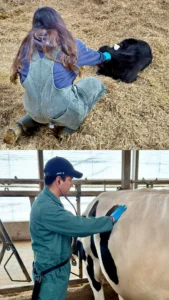
 Given the important of transition management to subsequent fertility in dairy cows, Dr. Ribeiro has also focused on understanding transition cow biology and developing tools to optimize transition management, ultimately improving reproduction and production efficiency in dairy cows. His extensive contributions in this area made it increasingly evident that health, not only at the time of breeding but months before, is imperative for optimal reproduction in cows, even when disease treatment protocols are in place. For instance, clinical disease within 21 days in milk (DIM) negatively affects pregnancy per AI up to 150 DIM, fetal survival in pregnancies established up to 305 DIM, milk production and culling rate up to 305 DIM. His research has shown that fertilization of oocytes, survival of the zygote to the morula stage, elongation of the conceptus, and survival of the fetus to term were all impaired in cows treated for disease.
Dr. Ribeiro and his group have expanded their research in this area to a more comprehensive and integrated approach, demonstrating that the lasting effects of postpartum disease are not exclusive to reproduction, but also impact milk production, culling, lifetime production, and profitability. They have also estimated the cost of postpartum disease by calculating revenues, expenses, and the residual cow value for each of the 5,085 cows enrolled in a study. The average cost of a clinical disease was estimated at $502, with additive effects when cows develop multiple clinical diseases. Sensitivity analyses showed that feed cost and milk prices cause important shifts in the estimated costs of disease, and that in most scenarios, investments to reduce the risk of diseases (e.g. through improved transition cow diets or facilities) result in excellent ROI. More importantly, their analysis showed that costs of disease are highly dependent on the long-term effects of the insult on milk production and, therefore, faster and more effective treatment could contribute to lessen the economic burden.
The lasting effects of disease, even after treatment and clinical resolution, reinforces that prevention is the most effective way to avoid performance losses associated with transition health. However, reliable methods to predict the risk of postpartum disease are lacking, and preventive measures are typically applied to the entire herd, ignoring individual differences in susceptibility or resilience. Identifying cows that are more likely to have a bad start on lactation would enable more selective management. Recently, Dr. Ribeiro’s groups have demonstrated that prepartum feed intake has important consequences for transition metabolism, health, and subsequent performance. To translate this information to commercial farms, they tested whether information of rumination time (RT), collected by wearable sensors, could contribute to health risk assessments. They found that RT in the week preceding calving could serve as a reasonable predictor of postpartum health and performance in parous cows, but not in nulliparous cows. The proposed classification of parous cows according to the identified threshold (≤ -53 min deviation from the herd average or ≥ 0.73 STD below the mean) resulted in the separation of 23% of the cows as high risk (HR, those below the threshold) and 77% as low risk (LR, those above the threshold). Compared to LR cows, HR cows had 3.2 times greater odds of postpartum clinical disease, a 428 kg reduction in 305-day milk production, a 36% reduction in the hazard of pregnancy through 210 days in milk (DIM), and a two-fold increase in the hazard of culling through 210 DIM. The incidence of metritis specifically was 16.2% in the LR cows and 37.2% in the HR cows. Dr. Ribeiro’s group is expanding this research to additional herds to further validate this approach and determine the threshold for RT deviation across different herds. Additionally, they are using machine learning to integrate multiple variables to enhance the accuracy of health risk assessments, and testing targeted intervention strategies aimed at reducing the risk of health problems in cows identified as high risk. Given the recent developments in dairy technology and data modelling tools, there are numerous opportunities to enhance streamlined monitoring systems, and Dr. Ribeiro’s group is well positioned to make important contributions in this area as well.