
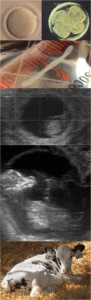
One of the goals of Dr. Ribeiro’s research program is to understand the normal progression of embryo development in vivo, as well as the deviations from the norm that lead to pregnancy loss – an important issue in dairy cows. In addition to identifying major risk factors for early embryonic mortality, his research has advanced the understanding of the molecular control of embryonic development in cows, particularly regarding the elongation phase of the preimplantation conceptus (i.e. embryo and its associated extra-embryonic membranes). Elongation is a prerequisite for successful pregnancy in ruminants and depends on histotroph secretion by the endometrium. Understanding this phase is critical, as it represents a major obstacle to the survival of approximately one-third of the viable blastocysts in dairy cows, according to his research conducted in both commercial and research herds.
His initial studies at Guelph investigated the composition of histotroph in the uterine luminal fluid (ULF) during diestrus and early pregnancy in cows, its association with known fertility stressors and genetic markers, and how it could be influenced by nutritional and pharmacological interventions. His results demonstrated that progesterone secreted by the corpus luteum during diestrus induces the accumulation of lipid droplets in endometrial epithelial cells, as well as selected lipids and oxylipins in the uterine lumen. The timely accretion of lipids works as a mechanism to supply these molecules to the developing conceptus at the onset of elongation, when substantial synthesis of biomass and cell signaling by lipid mediators are required. He also found that the composition of ULF during the breeding period is influenced by several factors, including the preceding incidence of postpartum uterine and non-uterine clinical diseases, postpartum inflammation without clinical signs of disease, the dynamics of body reserves mobilization after calving, and genomic markers of fertility. All these factors are known to affect reproductive efficiency in dairy herds, indicating that variability in ULF components, and its consequences to the developing conceptus, are likely part of the underlying mechanisms by which these factors affect fertility in cows. Moreover, recent results from Dr. Ribeiro’s group indicate that transition health management and genetic selection could be used to enhance the uterine environment to better support pregnancy. Dietary supplements such as organic trace minerals and calcium salts of fatty acids have also been shown to alter endometrial biology and ULF composition, thereby improving conceptus development in lactating cows.
His group is now focusing on the endometrial biology and how it regulates ULF composition and the development of the preimplantation conceptus. The physiology of the endometrium is influenced not only by ovarian steroids but also by paracrine effects of conceptus-derived bioactive products. The crosstalk between the endometrium and the conceptus regulates the environment in which the pregnancy develops in utero. Consequently, the endometrium’s ability to respond to conceptus signals is crucial for pregnancy development and survival, a phenomenon referred to as “endometrial receptivity to pregnancy. Using a novel in vivo test of endometrium receptivity, Dr. Ribeiro’s group characterized the variability of endometrial responses to a fixed dose of pregnancy-derived factor (i.e. interferon-tau) in 100 heifers and identified several markers associated with subsequent fertility. Interestingly, these markers were primarily genes that were expected to be downregulated by interferon-tau but failed to be downregulated in subfertile heifers. Their functions were mostly associated with cell signaling, metabolism, attachment, and migration, with a large representation of genes encoding extracellular proteins. While their in vivo model successfully served as a proof-of-concept, its feasibility for large-scale implementation is limited. Therefore, for current studies, Dr. Ribeiro proposed developing an ex vivo test to conduct fundamental research on endometrial biology and evaluate its contribution to reproductive failures in multiple herds.
Dr. Ribeiro is particularly interested in understanding how inflammatory conditions during the transition period affect long-term endometrial receptivity. His group has shown that the long-term consequences of postpartum disease on reproductive biology can persist for up to eight months after clinical resolution. Furthermore, he demonstrated that inflammation is responsible, at least in part, for the lasting effects of postpartum disease on reproduction, and that pharmaceutical and dietary interventions promoting a faster resolution of inflammation can mitigate these consequences. For instance, in a large randomized controlled trial, his group examined 2,700 fresh cows and enrolled 501 cows with metritis to evaluate the incorporation of meloxicam – a nonsteroidal anti-inflammatory drug – into the traditional treatment protocol for metritis. The proposed intervention improved subsequent lactation and reproductive performance in cows diagnosed with metritis, yielding outcomes that were intermediate between those treated with antibiotics only and the healthy control group, thereby lessening the consequences of metritis.
His group also investigated the supplementation of omega-3 fatty acids, known for their anti-inflammatory effects, in the diet of postpartum cows from 2 to 35 DIM. The dietary intervention enhanced puerperal endometrial repair, conception after the first AI, and the secretion of interferon-tau in the uterine luminal fluid compared with unsupplemented and isocaloric control groups.
Although impaired developmental competence of oocytes may contribute to the long-term consequences of inflammatory disorders on reproduction, Eduardo’s research suggests that the uterine environment is also a key factor. He evaluated the impact of postpartum health on fertility in cows receiving a viable embryo transfer on day 7 of the cycle, thereby isolating the potential effects of oocyte quality. His team found that both pregnancy and calving rates per embryo transfer were reduced in cows with a history of postpartum disease, similar to the reductions observed in cows that were inseminated. This result supports the idea that the uterine environment mediates at least part of the effects of disease on fertility. Interestingly, similar results were obtained when only uterine disease or only non-uterine diseases were considered, indicating that both types of disease have long-lasting effects on the uterine environment, impairing its ability to support pregnancy to term. Dr. Ribeiro’s working hypothesis is that postpartum inflammation exerts long-term modulation of endometrial receptivity through epigenetic mechanisms, impairing pregnancy development and survival. His long-term goals in this area of research are to advance fundamental knowledge of endometrial physiology and pregnancy survival; understand the biological mechanisms by which health or stress mediate enduring effects on uterine biology; and create management strategies to enhance uterine support for pregnancy development and reduce pregnancy losses.